
Children’s Dentistry: An Oral History
Surely the future of children’s dentistry began with changes to the ever-debated introduction of fluoride to water supplies and snack foods.
Surely it began in the 1940s with toothpastes and regular brushing becoming part of the bedtime ritual. Surely important things were learned from 1945-1954 Vipeholm experiments – other than how utterly cruel human beings can be, and how wretched life can be when you’re born into the wrong family at the wrong time with terrible things wrong with you.
For those unfamiliar with the study and possibly wishing they’d stayed that way, Vipeholm was a large, state-run Swedish hospital built in 1935 for adults and children with acute intellectual disabilities. It was not there to treat them; simply to house and segregate them from the socially acceptable misfits many of us are. It originally housed 650 patients for lifelong institutional care, a number that within ten years had swelled to more than a thousand. Given the severe levels of mental, physical and behavioural incapacities across so many people, the staff-to-resident ratio was apparently high at 1-to-4. It included psychiatric nurses and attendants, occupational staff, physicians and dentists.
You’d figure you wouldn’t have time to think, working in a facility like that, filled to the brim with the “feebleminded’ and “anti-social idiots”. In the 1940s no less; when knowledge and medications were limited. Whatever a lobotomy didn’t fix was post-surgically managed with abuse.
Somehow, in this bleak and brutal environment, coupled with the post WWII mandate requiring Swedish municipalities to provide constituents with dental care, the fact that nobody knew how to prevent cavities became forefront. Somehow, a place filled with people mostly tied their beds, unable to dress themselves, and fed slop if they could use a spoon, came to be the perfect venue for a long-term, highly monitored human experiment on dental health.
With or without the modern-day medical research protocols set by the 1947 Nuremberg Code, the study was inexplicably unethical. Many have been. We need to be deeply grateful for what has been learned from the pain and distress of others.
When the Swedish Medical Board commissioned the experiment in an endeavour to prove vitamin deficiencies were responsible for dental decay, funds were provided by Svenska Sockerfabriks AB (the Swedish sugar company). Its support encouraged various manufacturers within the confectionary industry to produce specialised, extra sticky, extra-sugary toffees and caramels designed to adhere to teeth. You can guess the dental horror it inflicted, on top of non-existent oral hygiene. Of 436 unwilling subjects, at least 50 were left with complete oral ruination. More than 2,100 caries were spread among them all.
So successful was this maximum decay strategy, it undeniably proved sugar and not vitamin deficiencies as the culprit of cavities. Empirical data was held back for years to allay the negative impact it would have on the global sugar industry.
The human disrespect and the damage it caused can never be justified. That it revealed eating sticky caramels and toffees between meals produced the most incidences of tooth decay seems a big so-what in the schemes that government authorities, and bona fide health professionals can come up with when nobody objects.
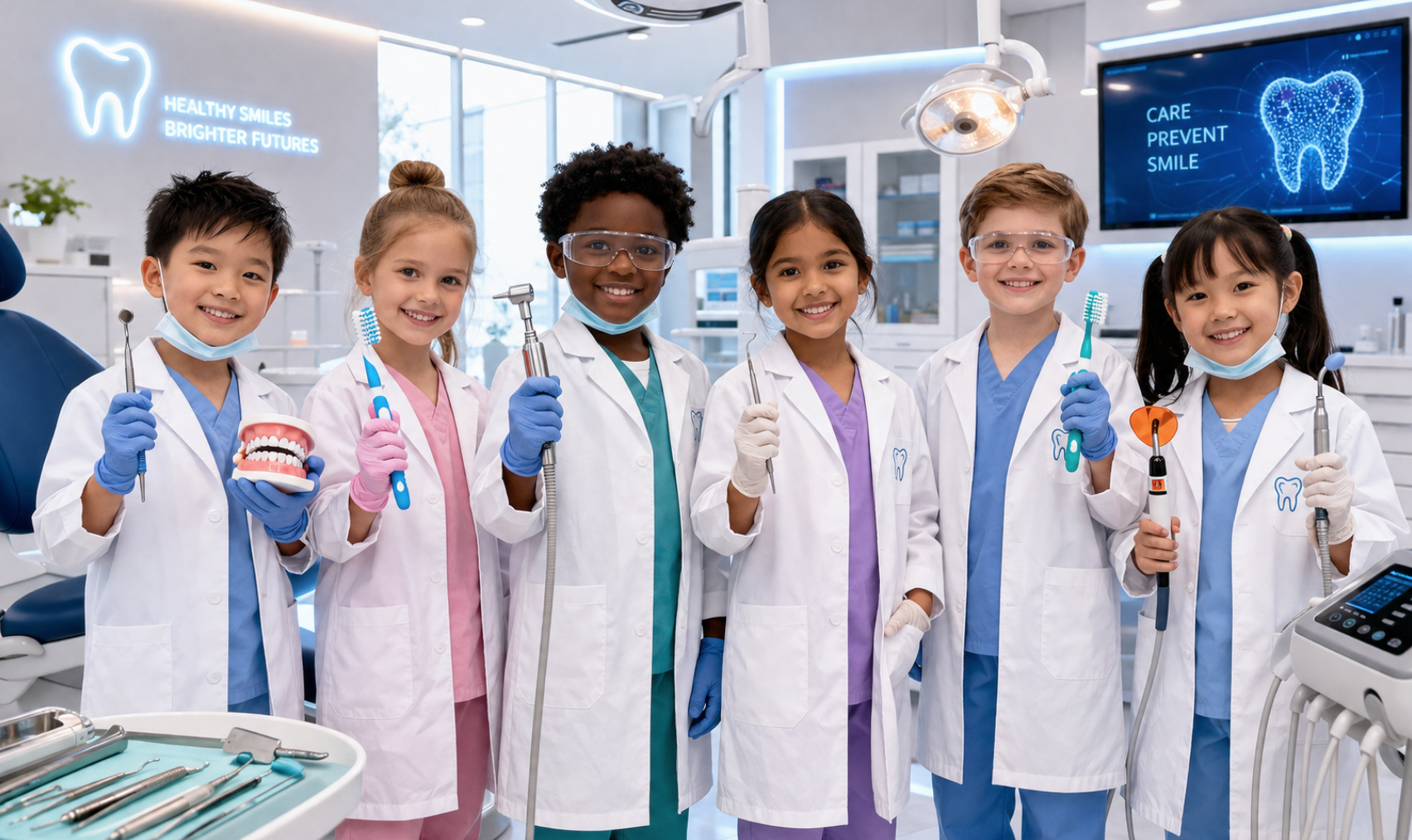
Certainly, and quite rightly, there have never been objections to the development of paediatric dentistry. Preventative care and treatments from babyhood to adolescence happens best in a kid-friendly environment; an idea first established in 1909 – which is probably much earlier than you thought.
In 2026, it’s a $US2.3 billion-dollar industry, attributed to increasing awareness of the value of oral health throughout childhood, in speech development, nutrition, concentration and self-worth. The significant public health challenge of the prevalence of tooth decay among children has lead to the expansion of school-based dental programmes.
Children’s dentistry has always focused on prevention, jaw development, diagnostics, sedation, emergency care, surgery, restorative procedures, early orthodontics and special needs management for the under-18s. If that doesn’t seem too different to general dentistry, specialists also address craniofacial growth patterns, space management strategies and evidence-based approaches to airway interventions and sleep disturbances.
The mental health impact of dental experiences on young patients is crucial. And so deeply understood in paediatric dentistry.
Markedly decreasing anxiety and pain during procedures and treatments through friendly and supportive design, sustains positive oral hygiene imprints and practices throughout the rest of their lives. Trends are also working towards eco-sustainability by actively reducing dependence on natural resources, while maintaining high standards in materials and care for our young Sunbury patients.
Intraoral scans and digital radiology are minimally invasive techniques that eliminate the need for making dental moulds.
No more strange, impression paste texture and gag-reflex sensations – a huge relief for patients and dental clinicians alike.
The Hall Technique, first developed in the 1980s, proved a simple and effective method for managing decay in milk teeth with no need for sedation, drilling or filling. Cementing a stainless steel crown over the offending tooth sealed it, and starved the decay of nutrients. The recently developed integrated approach removes the outer layer of dentin, and as an antimicrobial barrier, coats the tooth with silver diamine fluoride prior to bonding the crown.
It has a 92-98% success rate.
It’s not difficult to find the latest innovations in children’s dentistry. Each prioritises precision, patient comfort, minimally invasive techniques through technological advances; and compassion.
Everything so patently and desperately lacking at Vipeholm.